

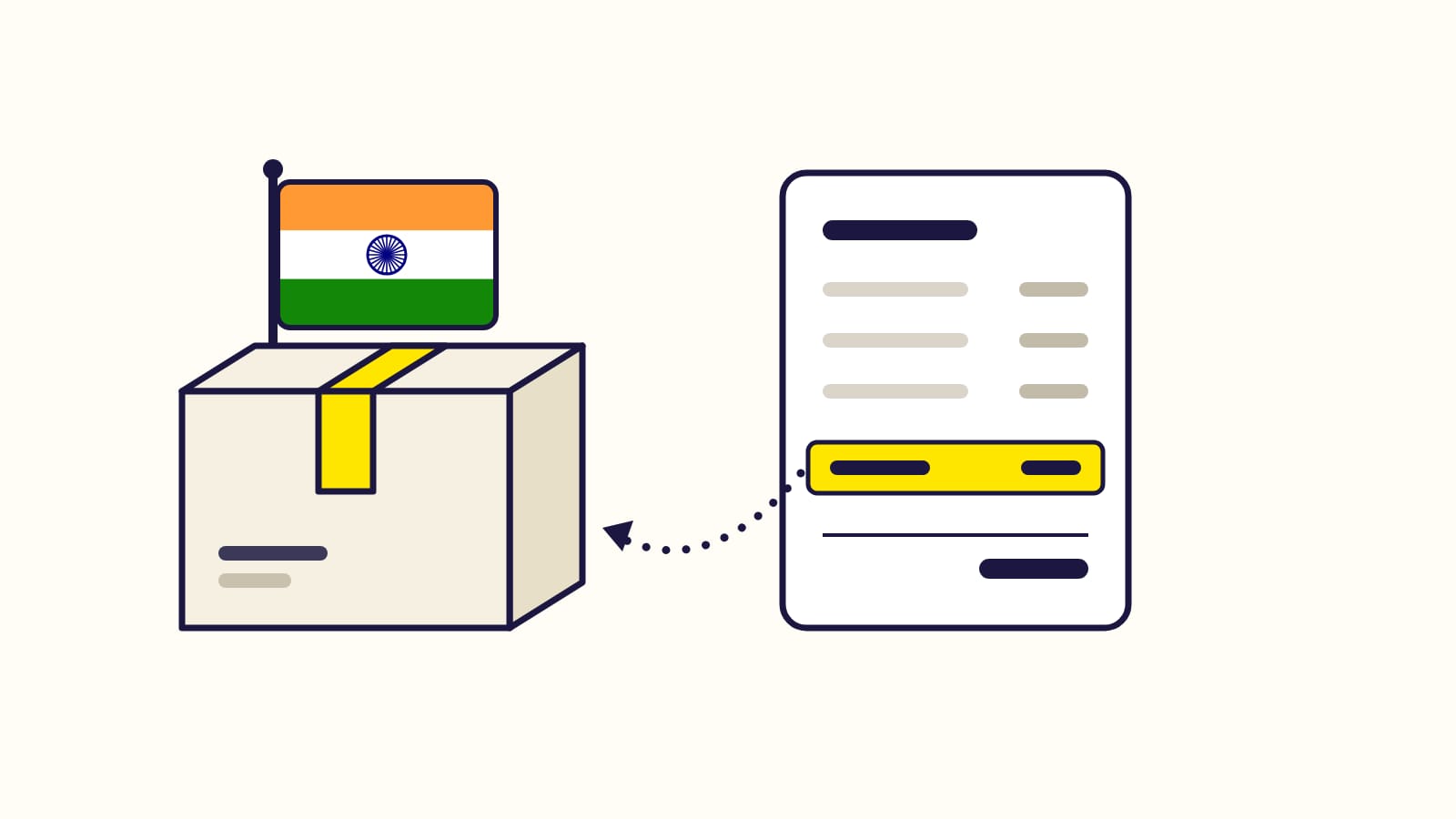
Amazon adds 18% GST to every rupee you spend on Amazon ads in India. A seller registered under the regular GST scheme gets all of it back as input tax credit, as long as the ad invoice carries the seller's GSTIN. A composition seller, or a seller of GST-exempt goods such as books, gets nothing back: for them the 18% is a pure cost. Exporters through Amazon Global Selling pay it on amazon.com ads too, in cash first, and recover it later as a refund.
For FBA and FBM sellers based in India, from the CGST and IGST Acts, CBIC notifications and Amazon's own pages, checked in October 2026.
Work out your figures with our free calculator, India preselected
In short
| Your situation | GST on your ads | What happens |
|---|---|---|
| Regular GSTIN | 18% | Claimed back as credit |
| Composition scheme | 18% | Lost: no credit |
| Exempt goods, no GSTIN | 18% | Lost |
| Exporter, amazon.com ads | 18%, paid in cash | Refunded later |
Who bills your ads, and what it adds
amazon.in ads are billed by Amazon Seller Services Private Limited, the "Amazon Contracting Party" when the country is India (Amazon Advertising Agreement). Online advertising is taxed at 18% (9% CGST + 9% SGST, or 18% IGST), under heading 9983 of Notification No. 11/2017-Central Tax (Rate); the September 2025 rate reform left it there.
Amazon confirmed it on its Indian seller forum: "All sales of Amazon Ads products and services to customers in India are subject to GST at 18%." Your ad invoices are in Seller Central, under Reports, Tax Document Library, Seller Fee Invoices.
amazon.com and the other foreign marketplaces bill you from abroad. Amazon's "Tax on Remote Services FAQ" is plain for India: if you give Amazon your tax ID, your fees are not taxed; if you do not, they are taxed, "advertising only".
Is your GSTIN on your ad invoices?
No GSTIN on the invoice, no credit. Input tax credit needs the invoice to be reported by the supplier in its GSTR-1 and to reach you (CGST Act, section 16(2)(aa)). An invoice issued without your GSTIN is a sale to a consumer: it never shows up in your GSTR-2B.
- Add your GSTIN in Seller Central: Account Info, VAT Information, "Add new VAT/GST Registration number" (Amazon Ads help, "Register your Tax ID").
- Download the ad invoices each month and check that both GSTINs are printed. Amazon's forum reply: "The invoice should contain your GSTIN and the supplier's GSTIN."
- Missing invoices or a missing GSTIN: open a case with Seller Support. Ads paid from the ads wallet were reported missing from the "Product Ads VAT Invoice" in the same forum thread.
Act before November 30. Amazon cannot correct an invoice after November 30 following the end of the financial year (section 37(3)), and you cannot claim the credit after that date either (section 16(4)), or after your annual return if you file it earlier. For ads billed between April 2025 and March 2026, the last day is November 30, 2026.
Small sellers: can you stay unregistered?
On amazon.in, almost never. The thresholds are ₹40 lakh for goods and ₹20 lakh for services (section 22 and Notification No. 10/2019-Central Tax), but they do not apply to you: anyone who sells through an e-commerce operator that collects tax at source must register, whatever the turnover (section 24(ix)).
- The 2023 exemption is narrow. Since October 1, 2023, a seller whose turnover stays under the section 22(1) registration threshold may sell goods through an e-commerce operator without registering, but only inside one State, with no inter-State sale, after declaring a PAN and receiving an enrolment number (Notification No. 34/2023-Central Tax).
- Amazon.in does not offer it for taxable goods. Its registration guide: "You can only sell GST-exempt products without a GST number by providing PAN details. For other products, it is mandatory to have a valid GST number to sell on Amazon.in."
So the real choice of a small seller is between the regular scheme and the composition scheme.
Regular or composition: what the 18% on ads changes
The composition scheme (section 10) is open up to ₹1.5 crore of turnover (Notification No. 14/2019-Central Tax). A trader pays 1% of turnover (0.5% CGST under rule 7 of the CGST Rules, plus the same SGST). In exchange:
- No credit at all, on ads or anything else (section 10(4));
- No inter-State sale (section 10(2)(c)): on Amazon, you sell only in your own State (Notification No. 36/2023-Central Tax).
Example. Priya sells home decor to consumers on amazon.in, at 18% GST, prices unchanged whatever her scheme. Each month: ₹2,00,000 of sales, ₹80,000 of stock (GST included), ₹30,000 of Amazon fees and ₹30,000 of ads, each plus 18% GST.
| Per month | Composition | Regular |
|---|---|---|
| GST on sales | ₹2,000 (1%) | ₹30,508 |
| GST credit | ₹0 | ₹23,003 |
| Left after costs | ₹47,200 | ₹41,695 |
Composition leaves Priya ₹5,505 more a month, about ₹66,000 a year, even though she loses every rupee of GST on her ads. The regular scheme recovers her ₹5,400 of GST on ads, but she pays 18% on sales to consumers, who cannot claim it back. The gap shrinks as your margin shrinks: with cheaper stock, composition wins by more; with costlier stock and fees, regular can win. What composition cannot give you is the rest of India: it stops you at your State's border.
Sellers of GST-exempt goods (books, for example) get no credit on ads used for exempt sales (section 17(2)): registering does not bring the 18% back.
Selling to businesses (B2B)
If your buyers are GST-registered businesses, the regular scheme costs them nothing: they claim the GST you charge, and you claim the 18% on your ads. That is the case where registration simply saves you 18% of your ad spend. In the calculator, choose "Seller to businesses (B2B)".
Exporting through Amazon Global Selling
On amazon.com ads, the 18% comes back, but only after you have paid it in cash.
- Give Amazon your GSTIN (Seller Central, VAT Information). Amazon then stops charging GST on your amazon.com ads.
- You pay 18% IGST yourself, by reverse charge, on a service bought from a supplier outside India (Notification No. 10/2017-Integrated Tax (Rate), entry 1). You pay it in cash: "the electronic credit ledger cannot be used for making payment of any tax which is payable under reverse charge" (CBIC Circular No. 172/04/2022-GST).
- You claim the same amount as credit. Your exports under a Letter of Undertaking (LUT) carry no GST (IGST Act, section 16), so the credit piles up.
- You claim the refund of unused credit (CGST Act, section 54(3)), within two years.
With ₹1,00,000 of amazon.com ads a month, ₹18,000 leaves your account every month and comes back with the refund. It is a cash advance, not a saving.
If Amazon has already charged GST on amazon.com ads although you are registered, ask for a refund: Amazon needs a "valid VAT/GST registration number" and proof that it "was active during the billing period" (Amazon Ads help, "Tax refunds").
TCS: what Amazon keeps from your sales
Amazon collects tax at source (TCS) on your net sales: 0.5% since July 10, 2024 (0.25% CGST + 0.25% SGST, or 0.5% IGST; Notification No. 15/2024-Central Tax). You claim it "in his electronic cash ledger" (section 52(7)) and use it to pay your GST. It changes nothing on your ads, but it is one more reason the regular scheme suits sellers who file every month anyway.
Frequently asked questions
Can I get back the GST on ads I bought before registering?
No. Amazon refunds tax only with proof that your registration "was active during the billing period", and only a registered person can claim credit.
Does the 18% on ads count against me under composition?
It is simply a cost: a composition seller "shall not be entitled to any credit of input tax" (section 10(4)). Count every ₹100 of ads as ₹118.
How do I get a binding answer for my business?
Ask for an advance ruling on the admissibility of input tax credit (CGST Act, section 97(2)(d)), in form GST ARA-01, with a fee of ₹5,000 under each Act. It binds the department for you (section 103).
Check your figures
Use the free Amazon Ads tax calculator, India preselected, then take the figure to your accountant.
Every rupee wasted on a click that never sells costs you ₹1.18 if you cannot claim the GST: add negative keywords on search terms that spend without selling, and check what happens to your ads when you run out of stock. Indian authors have their own case: KDP authors and the 18% GST.
Sources
- CGST Act, section 10 (composition), section 16 (credit), section 17, section 22, section 24, section 37, section 52 and section 54, CBIC
- Finance Act 2023, section 137 (composition sellers on e-commerce from October 1, 2023), GST Council
- Notification No. 34/2023-Central Tax, No. 36/2023-Central Tax, No. 15/2024-Central Tax, No. 10/2019-Central Tax and No. 14/2019-Central Tax, CBIC
- Notification No. 11/2017-Central Tax (Rate), entry 21, CBIC
- Notification No. 10/2017-Integrated Tax (Rate) and Circular No. 172/04/2022-GST, CBIC
- IGST Act, section 16 (zero-rated supply), CBIC
- Advance Ruling Mechanism under GST, GST Council
- Amazon Advertising Agreement ("Amazon Contracting Party"), Amazon Ads
- Register your Tax ID and Tax refunds, Amazon Ads help
- Tax on Remote Services FAQ, Amazon Seller Central
- How to get GST invoices for Amazon Ads Wallet paid Invoices (Amazon's reply), Seller Central India forum
- Seller registration guide, Amazon.in
Gloriads is an Amazon Ads automation platform that creates, monitors and optimizes Sponsored Products, Sponsored Brands, Sponsored Display and Streaming TV campaigns for sellers, brands, authors and agencies, by rules you control. See how it works.