

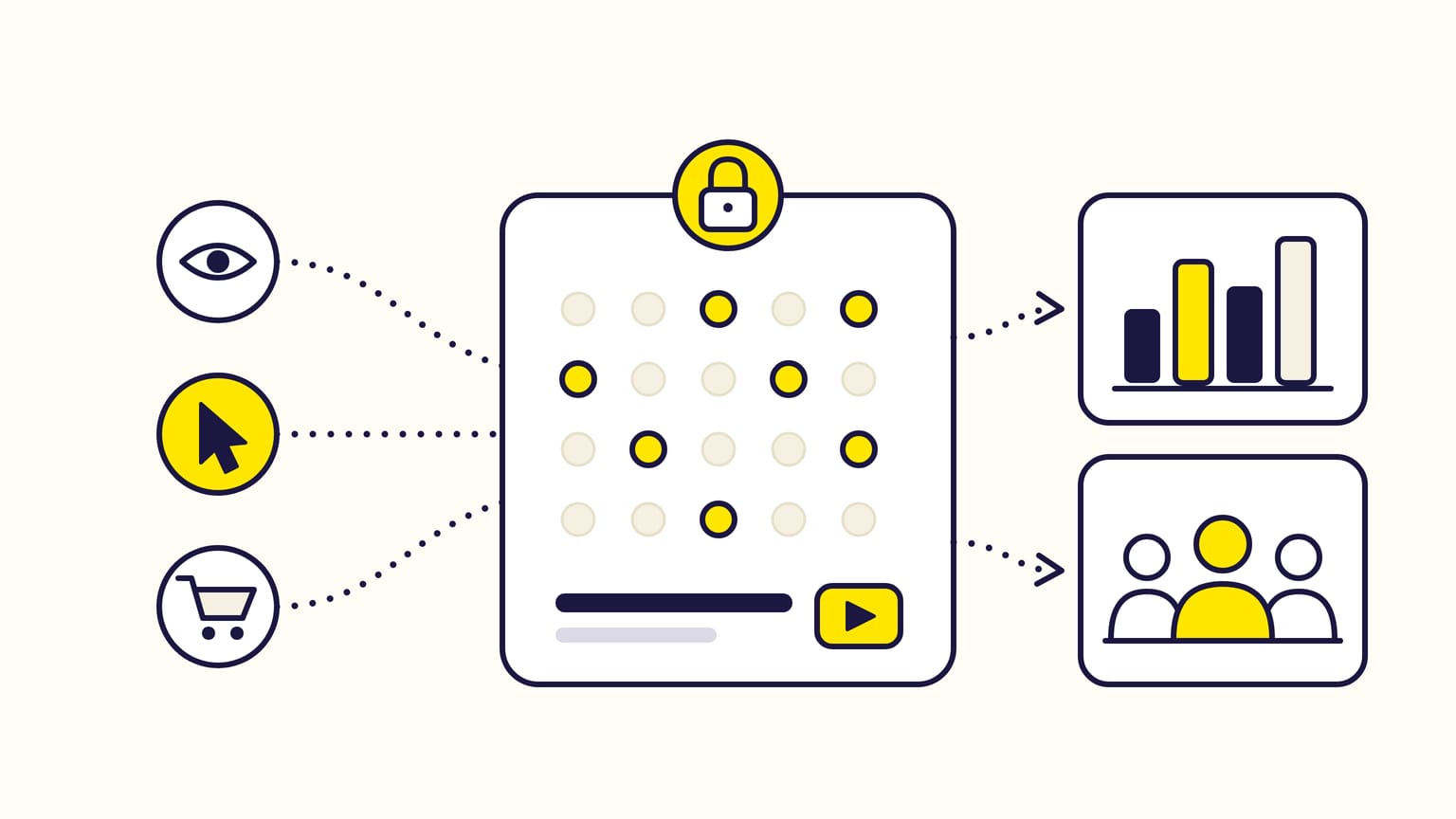
Amazon Marketing Cloud (AMC) is Amazon Ads' clean room: a private, secure space where you query your own ad events (each impression, click and conversion, tied to an anonymous shopper ID) and get back only aggregated, anonymous results. You query it in SQL, with no-code templates, or by asking Ads Agent in plain English, and you can turn a query into an audience for your ads. AMC is free, and since September 2025 every advertiser running sponsored ads can open it from the ads console.
Gloriads does not query Amazon Marketing Cloud; it keeps about six years of your Sponsored ads figures and lets your AI assistant read them through its read-only connector. See it in the live demo.
For sellers, vendors and agencies running Amazon ads. Checked against Amazon's help pages in November 2026.
Gloriads does not use AMC: it reads Amazon's standard reports, the ones behind the ads console. Want your Sponsored Products, Sponsored Brands and Display figures for every marketplace in one place, without SQL? That is the Gloriads dashboard. Open the live demo, no sign-up.
Jump to:
- What is inside an AMC clean room?
- How do you query AMC?
- Why are AMC results always aggregated?
- What can you learn with AMC?
- How do AMC audiences work?
- What does AMC cost?
- How do you get access to AMC?
- What are the limits of AMC?
Amazon Marketing Cloud at a glance
| Question | Answer |
|---|---|
| Who can use it | Every advertiser running sponsored ads; DSP advertisers through Amazon or a partner |
| Cost | Free; optional paid features |
| Data | Your ad events, up to 12.5 months back (25 announced) |
| How you query | SQL, no-code templates, or Ads Agent |
| What comes out | Aggregated reports and audiences, never one shopper |
| Where | Ads console, under Measurement & Reporting |
Amazon launched AMC in 2019; it now runs on AWS Clean Rooms. Access long went through an Amazon representative or a partner; on September 16, 2025, Amazon opened instant, self-service access to all sponsored ads advertisers.
What is inside an AMC clean room?
Your clean room is called an instance. Each instance holds the records of one advertiser. Several Amazon DSP and sponsored ads accounts can share it if they belong to the same company, but you cannot query across two instances.
| Table | What it holds |
|---|---|
| Sponsored ads traffic | Each impression and click of your Sponsored Products, Sponsored Brands and Display ads |
| Amazon DSP traffic | Your DSP impressions, clicks and views |
| Attributed events | Each conversion (purchase, detail page view, off-Amazon event), linked to the ad it is credited to |
| Conversions | Conversions to credit yourself, with your own rules, up to 28 days back |
You can add your own data: a customer list, in-store sales, product details. AMC accepts only pseudonymized records (a hashed email, for example), uploaded through Ads Data Manager or the AMC API. It matches them to its own anonymous shopper ID and drops your identifiers. Amazon says it never accesses your instance, your uploads or your queries.
Each instance keeps up to 12.5 months of your Amazon Ads events; older records age out.
Amazon announced 25 months of ad traffic in November 2025, in open beta in the US and Canada first, with other countries planned for early 2026. Its help page, updated in February 2026, still says 12.5 months: check the period your own instance shows.
How do you query AMC?
| Way | What you get |
|---|---|
| Insights cards | Ready analyses on the home page: path to conversion, time to conversion, overlap of campaign groups |
| Use case library | Amazon's own queries, some as no-code templates that ask only for campaigns, ASINs or similar inputs |
| Ads Agent in AMC | Plain English turned into SQL, with an explanation |
| Query editor | Your own SQL |
AMC SQL is a custom version of SQL. It refuses SELECT *, LIMIT and
RIGHT JOIN, and checks every query against its privacy rules before it runs. To
practise, each AMC account gets a sandbox: an instance filled with synthetic
data, tied to no real campaign or shopper.
Amazon warns that Ads Agent "can make mistakes": check the SQL it writes before you trust the result.
Why are AMC results always aggregated?
Nothing in AMC can single out a shopper. You can count shoppers, never list them: the shopper ID can be used inside a query but never shown in its result.
Each row of a result must also cover a minimum number of distinct shoppers:
- 2 for campaign columns, such as the campaign or ad ID;
- 100 for sensitive columns, such as a postal code or a bid price.
A row below its minimum comes back empty (NULL). Amazon's example: purchases by postal code returned 95 rows, 4 of them without a postal code because fewer than 100 customers bought there. Those 4 rows held 183 of 12,000 purchases, 1.5%. To fill such rows, widen the dates, drop a dimension or remove a filter.
What can you learn with AMC?
Amazon's own examples:
- The path to conversion: which ads, in which order and how often, come before a purchase, and how long it takes.
- Overlap between ad types: how many shoppers saw both your Sponsored Products and your DSP ads, or the extra reach DSP added to your sponsored ads.
- Reach and frequency: how many shoppers you reached, and how many ad views work best before a sale.
- Custom attribution: first touch, last touch, linear or position-based credit, up to 28 days back, instead of Amazon's standard last-touch model.
- Your whole business, with your own data: the share of your customer list your ads reached, or of your off-Amazon sales they influenced.
How do AMC audiences work?
An AMC audience is a query that returns shoppers instead of a report. You write it (or start from a template or Ads Agent) and pick one of two types:
- Rule-based: the shoppers who match your rules, such as "added to cart but did not buy" or "engaged with my ads but never purchased".
- Lookalike: shoppers similar to a seed group, such as your best customers, from "Most similar" to "Most broad".
The audience needs at least 2,000 records, takes up to 48 hours to be ready, and goes straight to your ads accounts, its name starting with "AMC". It can never be downloaded.
Where you use it:
- Display: as a target, next to Amazon's own audiences (how Display retargeting works).
- Sponsored Products and Sponsored Brands: to raise your bid for those shoppers.
- Amazon DSP: in an ad group, like any other audience (Sponsored Display vs Amazon DSP).
Amazon advises trying its standard audiences first, and building AMC audiences for needs they do not cover.
What does AMC cost?
AMC itself is free: "available at no cost to eligible advertisers", in its web interface and its API, and running a query adds no charge. Three things can cost money:
- Paid features (beta): extra tables from Amazon Ads and third parties such as Experian and NCS, billed monthly per instance, each with a 60-day free trial. You see the price before you subscribe and can cancel at any time.
- A partner: agencies and software vendors that write queries for you set their own prices.
- Your ads: AMC changes nothing in what your campaigns cost.
How do you get access to AMC?
- You run sponsored ads: in the ads console, open Measurement & Reporting in the left menu, then Amazon Marketing Cloud. Instant access creates an instance for your sponsored ads account within minutes.
- You run Amazon DSP, or want several advertisers in one instance: ask your Amazon Ads account executive or a partner. Amazon then sets up an AMC account, whose admin creates instances and adds users.
- Through a partner: agencies and software vendors of the Amazon Ads Partner Network can run AMC for you.
Developers can also reach AMC by API, for reports, audiences and data uploads.
What are the limits of AMC?
- Small numbers disappear: a small campaign or a narrow cut returns empty rows.
- No organic sales: AMC's conversions are those linked to an ad (and to your pixels). A sale no ad touched is not in it.
- One advertiser per instance, and no query across instances.
- About one to two years of history: up to 12.5 months per instance on Amazon's help page, 25 months announced in November 2025.
- Its totals can differ from the console: Sponsored Products and Display report sales on the day of the ad (click or view), Sponsored Brands and DSP on the day of the sale. AMC has a table for each way; pick the matching one.
- SQL beyond the templates: the no-code templates cover common questions; anything else needs SQL, written by you, Ads Agent or a partner.
- Audiences are slow and large: 2,000 records at least, up to 48 hours.
Frequently asked questions
Is Amazon Marketing Cloud the same as Amazon DSP?
No. Amazon Marketing Cloud is an analytics clean room: it measures ads and builds audiences. Amazon DSP is a platform that buys display, video and audio ads. AMC reads DSP campaigns and sends audiences to them, but it buys nothing.
How is AMC different from the ads console reports?
The ads console reports give fixed metrics per campaign, target or search term, such as the search term report. AMC lets you query each ad event yourself, with your own metrics and across ad types. Amazon presents AMC as a complement to standard reports, not a replacement.
Do I need to know SQL to use Amazon Marketing Cloud?
No, not for common questions. The home page's Insights cards, the no-code templates of the use case library and Ads Agent in AMC work without writing SQL. Custom analyses, and audiences beyond the templates, need SQL.
Which countries is Amazon Marketing Cloud available in?
Amazon lists the US, Canada, Mexico, Brazil, the UK, Germany, France, Italy, Spain, the Netherlands, Belgium, Sweden, Turkey, Saudi Arabia, the UAE, Japan, India and Australia on its AMC page.
Sources
20
- Amazon Marketing Cloud (who can use it, cost, countries), Amazon Ads
- Amazon Marketing Cloud now available to all advertisers running sponsored ads campaigns, Amazon Ads, September 18, 2025
- Unlock insights with AMC's expanded ad traffic lookback window (25 months), Amazon Ads, November 11, 2025
- Direct access to AMC for sponsored ads advertisers, Amazon Ads, September 16, 2025
- Learn about Amazon Marketing Cloud, Amazon Ads
- Accessing Amazon Marketing Cloud, Amazon Ads
- Amazon Marketing Cloud accounts and instances, Amazon Ads
- Amazon Marketing Cloud privacy, Amazon Ads
- Amazon Marketing Cloud SQL, Amazon Ads
- Aggregation thresholds, Amazon Ads
- Traffic tables, Amazon Ads
- Attributed events and conversion tables, Amazon Ads
- First-party signals in Amazon Marketing Cloud, Amazon Ads
- Amazon Marketing Cloud Home page, Amazon Ads
- The use case library, Amazon Ads
- Getting AMC help with the Ads Agent in AMC, Amazon Ads
- Amazon Marketing Cloud sandbox, Amazon Ads
- Custom audiences in Amazon Marketing Cloud, Amazon Ads
- Create a lookalike or rule-based audience, Amazon Ads
- Paid features, Amazon Ads